Mrs. Broadwith takes in and cares for Miss Stubbs’s pets
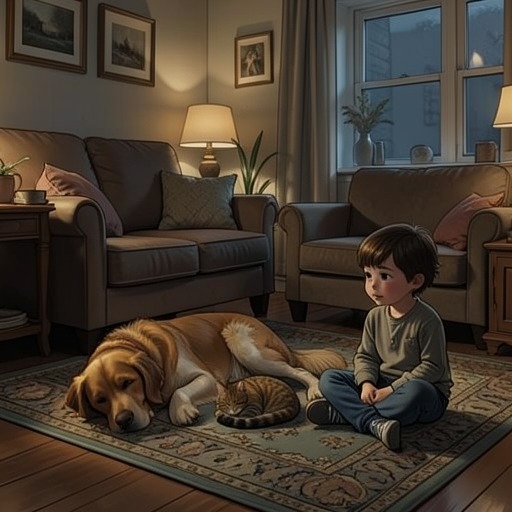
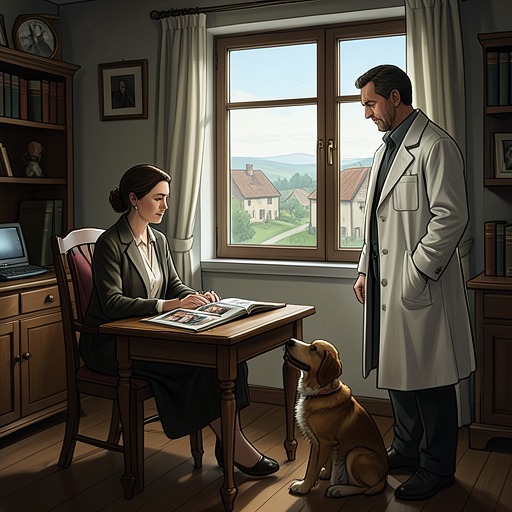
All Creatures Great and SmallMrs. Broadwith takes in and cares for Miss Stubbs’s pets after Miss Stubbs’s death, turning an abrupt loss into a practical act of continuity. The sequence begins with an evening summons when Ben collapses, pauses over Miss Stubbs’s composed farewell to the old dog, and resumes weeks later when James Herriot discovers that she has died and fears for the remaining animals. Mrs. Broadwith’s promise that the dogs and cats will have a home for as long as they live resolves that fear through care rather than ceremony.
The evening summons and Ben’s collapse
The episode opens at six o’clock in the evening, when James Herriot receives an urgent call from Mrs. Broadwith. Ben has collapsed. Herriot leaves at once and reaches the cottage in less than ten minutes, crossing the overgrown grass in the front garden while the other animals watch from the window. Their barking greets his knock, but Ben’s voice is missing. Inside, the old dog lies very still on his side beside the bed. The contrast between the dogs’ familiar noise outside and Ben’s silence makes his collapse immediately legible as a change in the household, not simply a veterinary emergency.
The cottage is also a place of long companionship: Miss Stubbs has shared her life with Ben for many years. Herriot’s first response is practical and swift. He wants to get the dog out of the room as quickly as possible, so he pulls a blanket beneath him and lifts him. That impulse is interrupted when Miss Stubbs asks him to wait. Her small request shifts the scene from the business of carrying Ben away to the bond between the woman and her companion.
Miss Stubbs’s farewell
Miss Stubbs is described as composed, with no tears and a fixed expression as she looks down from the bed. She makes an effort to turn onto her side, gazes at Ben, and lightly touches his head. The gesture is brief, but it is the scene’s emotional centre: Herriot’s urgent handling gives way to a moment in which Miss Stubbs can acknowledge her companion herself. She then lies back calmly as Herriot carries Ben from the room. The account does not linger on clinical particulars; it gives weight instead to the pause she insists upon and the touch she chooses to offer.
Afterward, Herriot returns and sits beside the bed. Miss Stubbs looks out of the window for a few moments before turning to him and remarking casually that her own turn will come next. The matter-of-fact delivery sits beside the effort she has just made to say farewell. Her remark is not presented as a dramatic announcement, but it acquires significance in the sequence that follows: about a month later, Herriot learns that he had seen her for the last time.
The preceding conversation about whether animals have souls lends the parting an additional context. Miss Stubbs had worried about the question; Herriot answered by connecting a soul with the capacity for love, loyalty, and gratitude, qualities he believed animals plainly possessed. This exchange does not settle a doctrine about the afterlife. It shows, instead, that the relation between Miss Stubbs and her animals is understood through the attachment and devotion they share. The later concern over their future continues that same recognition in practical form.
The news arrives by chance
Herriot does not learn of Miss Stubbs’s death through a direct message. About a month after their last meeting, while on his rounds, he happens to hear from a farmer that the cottage in Corby village is up for sale. The news makes him realize that Miss Stubbs has died. The account stresses how easily such a death can pass without notice: she was a lonely, penniless old woman, and no one is likely to rush into the street to tell a veterinarian. This accidental discovery gives the episode its sharpest break. The absence of formal news is not an absence of consequence; Herriot immediately thinks of the animals she has left behind.
His first question is what has happened to the dogs and cats. When he reaches Mrs. Broadwith, he cannot contain his concern and blurts out the question again. The repeated inquiry marks the practical stake of the discovery: the animals’ circumstances remain uncertain until someone tells him where they are. Mrs. Broadwith answers calmly that they are in the garden, where she has room for them. She gets up and opens the door, and Herriot watches his old friends pour in. The movement from uncertainty to recognition happens through an ordinary action—a door opened onto a garden—rather than through a formal account of arrangements.
A permanent home for the animals
Mrs. Broadwith makes clear that the animals are not there temporarily. She says they are with her for good, that she thinks of them as Miss Stubbs did, and that she could not be parted from them. She promises they will have a good home with her for the rest of their lives. Her commitment answers the question Herriot has carried from the cottage: the dogs and cats will not be separated from the person willing to care for them, nor left without a settled home after their owner’s death.
The transfer is described through the animals’ arrival and Mrs. Broadwith’s assurance, not through details of how each pet was moved or how many there were. Its significance lies in the certainty she provides. Miss Stubbs’s death has ended her direct care, but the animals’ place in a human household continues. Mrs. Broadwith does not merely offer space in her garden; she accepts lasting responsibility and speaks of an attachment comparable to Miss Stubbs’s own.
The episode therefore links a private farewell to a later act of protection. At the cottage, Miss Stubbs’s light touch gives her time with Ben before Herriot carries him away; afterward, her concern for animals is taken up by Mrs. Broadwith, who keeps the dogs and cats together in a home. Herriot’s alarm supplies the connection between the two moments: once he learns Miss Stubbs has died, he seeks the animals, and the relief of seeing them safe becomes the ending. Their future is secured not by a claim about what happens after death, but by a living person’s promise to care for them for as long as they live.